
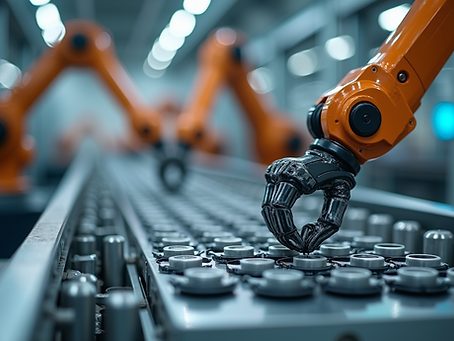
In today's fast-paced world, manufacturing is evolving rapidly. Companies are looking for ways to improve efficiency, reduce costs, and enhance product quality. One of the most effective ways to achieve these goals is through industrial automation. This blog post will explore various industrial automation solutions that are transforming modern manufacturing.
Automation is not just a trend; it is a necessity for businesses that want to stay competitive. By integrating advanced technologies, manufacturers can streamline operations and respond quickly to market demands.
What is Industrial Automation?
Industrial automation refers to the use of control systems, such as computers or robots, to handle different processes and machinery in an industry. This technology can be applied to various manufacturing processes, including assembly lines, material handling, packaging, and quality control.
The primary goal of industrial automation is to increase productivity while minimizing human intervention. This leads to fewer errors, lower labor costs, and improved safety.
Benefits of Industrial Automation
Increased Efficiency. Automation allows machines to operate continuously without breaks. This leads to higher output and faster production times. For example, a fully automated assembly line can produce thousands of units per hour, far exceeding manual labor capabilities.
Improved Quality. Automated systems are designed to perform tasks with precision. This reduces the likelihood of defects and ensures consistent quality. For instance, robotic arms can assemble components with exact measurements, leading to fewer errors.
Cost Savings. While the initial investment in automation technology can be significant, the long-term savings are substantial. Companies can reduce labor costs and minimize waste, leading to higher profit margins.
Enhanced Safety. Automation can take over dangerous tasks, reducing the risk of workplace injuries. For example, robots can handle heavy lifting or work in hazardous environments, keeping human workers safe.
Flexibility. Modern automation solutions are highly adaptable. Manufacturers can easily reprogram machines to accommodate new products or changes in production processes. This flexibility is crucial in today's rapidly changing market.
Types of Industrial Automation Solutions
Fixed or Hard Automation. Fixed automation involves the use of specialized equipment to automate a specific set of tasks. This type is ideal for high-volume production where the same product is made repeatedly. For example, automotive assembly lines often use fixed automation to produce vehicles efficiently.
Programmable Automation. Programmable automation allows for the reprogramming of machines to handle different tasks. This is suitable for batch production where products change frequently. For instance, a bakery may use programmable machines to switch between different types of bread.
Flexible Automation. Flexible automation systems can adapt to changes in product design or production volume. This type is beneficial for manufacturers that produce a variety of products in smaller quantities. For example, a clothing manufacturer may use flexible automation to create different styles and sizes.
Industrial Robotics. Robots are a significant part of industrial automation. They can perform tasks such as welding, painting, and assembly with high precision. For example, a robot can paint a car body uniformly, ensuring a flawless finish.
IoT and Smart Manufacturing. The Internet of Things (IoT) is revolutionizing manufacturing by connecting machines and devices. Smart manufacturing uses data from connected devices to optimize production processes. For instance, sensors can monitor equipment performance and predict maintenance needs, reducing downtime.
Implementing Automation in Your Manufacturing Process
Transitioning to automation can be a complex process. Steps to consider: assess your current processes to identify where automation can improve efficiency or quality; set clear goals for what you want automation to achieve; choose the right technology for your scalability and compatibility needs; train your workforce so they can operate and maintain the new systems; and continuously monitor and optimize performance after implementation.
Real-World Examples of Industrial Automation
Tesla has revolutionized the automotive industry with its use of automation, employing advanced robotics to allow high-speed production of electric vehicles while maintaining quality at scale.
Amazon uses automation extensively in its warehouses — robots transport goods and automated systems manage inventory, allowing orders to be fulfilled quickly.
Coca-Cola has implemented automation in its bottling plants, with automated systems handling everything from filling to packaging, increasing efficiency and reducing labor costs.
Challenges of Industrial Automation
The benefits are significant, but so are the challenges: high initial costs that must be weighed against long-term savings; workforce displacement that needs to be addressed through retraining; the technical complexity of implementing and maintaining automated systems; and the challenge of integrating new automation with existing processes.
The Future of Industrial Automation
Looking ahead, expect to see deeper integration of artificial intelligence for real-time decision-making, collaborative robots ("cobots") working safely alongside people, advanced analytics driving continuous process improvement, and a growing focus on sustainability as automation helps reduce waste and energy consumption.
Embracing the Automation Revolution
Industrial automation is transforming modern manufacturing. By embracing automation solutions, companies can improve efficiency, enhance quality, and reduce costs. The journey toward automation may have its challenges, but the rewards are well worth the effort for manufacturers ready to invest in the right solutions.